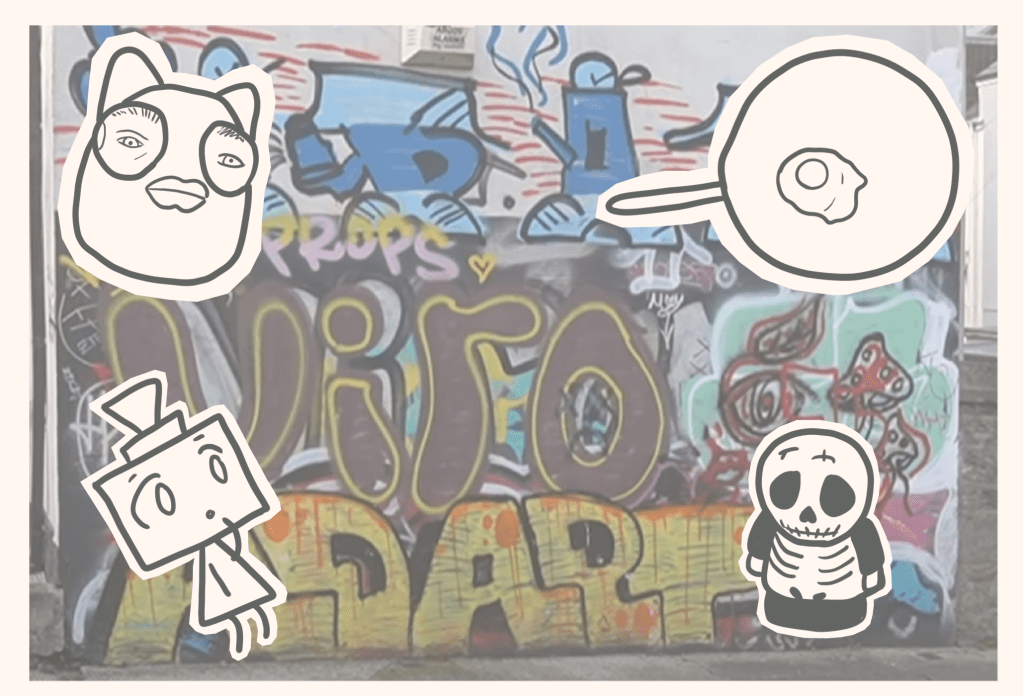
I have noticed a recurring element across my films — that once an object is used, or a place is visited and shown on camera, it suddenly feels special. Yes, this applies to props I made specifically for films, but it also applies to the ordinary.
“This frying pan was used in ‘Eggistential’”, “‘After Images’ was filmed over there, above the barber shop”, and “this piece of wall art was made by so-and-so, I learnt that when making ‘Graffiti’”.
Random household utensils, nightclubs, and art made by strangers who are hoping to stay strangers. These mundane elements of life. The minutiae. The trivial. They all suddenly have importance to me, and the way I process the world. By giving something attention, you give it importance.
It made me wonder, if my practice is trying to ‘force chance’ in order to make discoveries, could you forcibly ‘sanctify the mundane’? Are we able to purposely create value out of anything and everything?
By allowing us to form connections with the world around us without bias, then suddenly the larger world has value outside of expectations of what should and shouldn’t be focused on.
What does that mean for us caring for each other? The environment? Historical and societal conservation? I know that I struggle to unsee the label of importance on something once it has been applied. All value is decided by people — it is largely arbitrary. So why not spread the love of what should and should not be cared for?
This also removes hierarchy and prioritisation. You could argue “are priorities not a good thing?” and I annoyingly have to ask two separate questions in response. “Are our current priorities working?” and “Whose priorities are they really?”. The idea of “We cannot focus on this because there are bigger issues” means that everything else is just ‘not important’. The reality of the situation is that there is no ‘we will get to that later’ — there will always be something else ‘which is important’ that will take its place. If you think about what is important, it’s often politics — games being played by people in power, where they are more often than not the ones who benefit. An ‘all attention is good attention’ situation. If that is the case, then why not share out attention? A fixation that is not the norm is seen as a disruption from life, but often a disruption from the status quo is what is needed. We are animals, and the system in which we find ourselves in is not the ‘default’ — it is constructed and maintained by those for whom it benefits.
It is funny that these conversations come about as a result of my ‘silly little videos’ but that is kind of the point. By allowing yourself to drift away from what other people see as important, in lots of directions, you can start to see an alternative picture, tied to many aspects of one’s life.
Not only that, if you incorporate random parts of your life into what you do (be it art, work, routine) you create an appreciation for them and the desire to protect them.
It makes me think about a moment I had as a child. I was at my grandfather’s place for dinner, and two older men came over to join us. I had no idea who they were, but they were so kind. Listening when I spoke, being enthusiastic with others. Just a real joy to be around. At the end of the night, I really thought ‘that was so nice’. Later, some of my family members were having a conversation about how they were gay. This was my first time interacting with anyone who was gay (as far as I knew). Growing up in South Africa, being gay was seen as one of the ultimate insults — to not be manly enough. I, however, always thought about those nice old men. To insult them did not feel right. A chance occurrence. A singular nice moment. This was enough. I had some form of context for what ‘gay’ could be.
While that may seem like a large outcome, it is worth remembering that it all spawned from a nice meal.
…
My films are not these amazing masterpieces, which are so drenched in detail that you cannot help but be a changed person by the end of each viewing. However, piece by piece, the creation of these films have changed my perception of the world around me. I mean that on a micro-scale, which develops into a macro-scale.
There is this snowball effect of understanding. Once you make a connection in your brain between the ‘ordinary’ and something else, more connections start to rush towards the ‘ordinary’. Suddenly, the ‘ordinary’ is interlocked with so many ‘important’ aspects of life, that you wonder ‘how on earth could I have not noticed how tied to everything this ordinary thing is?’. Well, you just made it ‘important’.
This realisation and reality are one and the same. The world is all noise. Everything. The labels you attach to entities within the noise elevates them to being recognised — separated from everything else.
So, to give something value, is merely to pay attention to it, hold it in your thoughts for a while, and see how it connects or relates to something else. I wanted to say, ‘everything else’, and while that is true, these additional connections happen on their own, whether you want them to or not, and also, everything may take a little too long given how much time we have. It is why we need to work together to cover our bases.
…
This is part of the reason why I really like local film productions and publications. Often, they are looking at something ‘small’ in the local community. A church, a school, a music production, an old fire station, a local resident’s history. Someone (a filmmaker) spent their time getting really interested in something ‘small’ and shared it with everyone. They immortalised a moment.
By me consuming it, and putting my interest on it, this connection is suddenly shared. When I walk past said ‘church’ or ‘school’, it is no longer just a building. It is other people’s lives and interests and histories. It gives an appreciation of sonder.
When walking through the city, there are areas I’m fond of because moments happened there. Why not try to create moments everywhere, so everywhere feels like that? Make every part of your physical map connected to a node in your mental map?
…
Maybe that is the most radical stance available to us — to refuse the invisible hierarchy of what is worth noticing. To assign value not just to the ‘spectacular’, but to whatever happens to be in front of us. Make sacredness ambient — not locked behind institutions, galleries, breaking news, or cultural permission, but evenly distributed across frying pans and bus stops and stairwells and back alleys.
 Brandon John Barnard
Leave a comment